Allowing thoughts to arise and dissolve
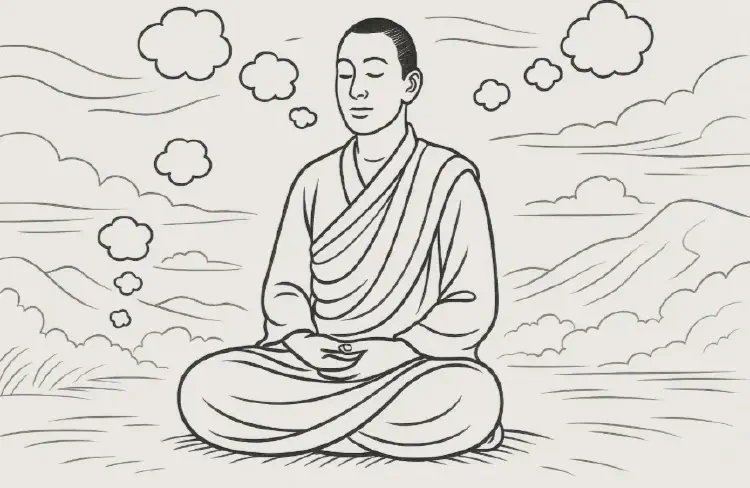
In Dzogchen, thoughts are not seen as obstacles but as natural expressions of awareness. The key is to let them arise and dissolve without interference, revealing their self-liberated nature.
- Dzogchen Essentials
- 2 min read
Article 4 of 6 in Semde Practices/
The Natural Process of Thoughts:
- Thoughts and emotions are like waves on the surface of the ocean—they arise, move, and dissolve naturally.
- When recognized within awareness, they leave no lasting trace.
- Problems occur only when we cling to or resist them.
Dzogchen Approach:
- Unlike some methods that suppress thoughts, Dzogchen encourages allowing them to come and go freely.
- The practitioner rests in rigpa, observing thoughts without grasping or rejecting.
- By not interfering, the true nature of thoughts as transient and empty becomes clear.
Practical Instructions:
- Sit in a relaxed posture, resting in natural awareness.
- When a thought arises, notice it without judgment.
- Instead of following the thought, recognize the space in which it appears.
- Allow it to dissolve naturally, like a cloud vanishing in the sky.
Analogies Used in Dzogchen:
- Clouds in the sky: Thoughts arise but never stain the sky-like awareness.
- Writing on water: Thoughts vanish instantly without leaving a mark.
- Echo in a valley: A sound arises and fades, leaving no substance behind.
Benefits of Allowing Thoughts to Arise and Dissolve:
- Reduces struggle with the mind, replacing suppression with ease.
- Reveals the openness and clarity of awareness.
- Strengthens confidence in the self-liberating nature of rigpa.
Reminder:
- The aim is not to stop thinking but to see the nature of thoughts.
- Every arising thought becomes a reminder of awareness.
In summary, allowing thoughts to arise and dissolve is central to Semde practice. It transforms the seeming obstacle of mental activity into a gateway for recognizing rigpa.
You might also like:
- Tags:
- Dissolve Naturally
- Natural Awareness
- Practical Instructions
- Thoughts Arise
- Recognizing Rigpa
- Self Liberating
- Naturally Like
- Like Waves
- Strengthens Confidence
- Instructions Sit
- True Nature
- Dzogchen Approach
- Analogies Used
- Relaxed Posture
- Mental Activity
- Practical Instructions Sit
- Dissolve Naturally Like