Releasing fixation on body and senses
Longde practices teach that awareness is not limited to the body or the senses. By releasing fixation, practitioners recognize that awareness pervades all experiences without being bound by them.
- Dzogchen Essentials
- 2 min read
Article 4 of 6 in Longde Practices/
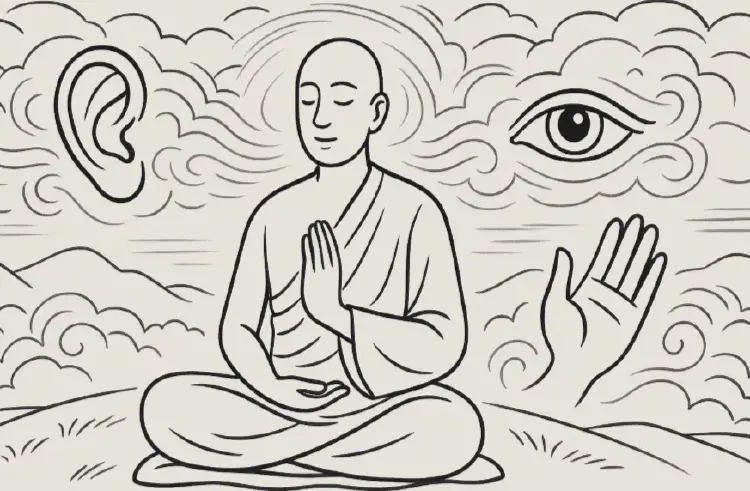
The Habit of Fixation:
- Ordinary mind clings to the body and sensory perceptions as solid and real.
- This creates duality: a perceiver inside the body experiencing an external world.
- Fixation strengthens attachment, aversion, and the illusion of separation.
Dzogchen Approach:
- Awareness (rigpa) is not confined to the body or senses—it is vast and boundless.
- Body and senses are seen as expressions of awareness, not containers or prisons for it.
- By releasing fixation, one discovers that sensations and perceptions self-liberate within openness.
Practical Instructions:
- Sit in a relaxed posture, letting the body rest naturally.
- Open awareness to all sensory experiences—sight, sound, touch, smell, taste—without focusing narrowly.
- Notice how sensations arise and dissolve spontaneously without clinging.
- Recognize that awareness is not limited to the body’s boundaries but spacious and unobstructed.
Key Experiences in Practice:
- Lightness and freedom from bodily identification.
- Sensations arise like ripples in space, not as fixed realities.
- A sense of interconnectedness where body and world are unified in awareness.
Benefits of Releasing Fixation:
- Reduces clinging to the body and fear of its suffering or death.
- Transforms sensory experiences into gateways for recognizing awareness.
- Supports realization that rigpa is vast, not bound by form.
Analogy:
- Just as reflections appear in a mirror but do not alter the mirror, sensory experiences appear in awareness but do not limit it.
Summary: Releasing fixation on body and senses helps practitioners recognize that awareness is not confined to form. Instead, body and senses become expressions within the vast openness of rigpa, freeing experience from dualistic grasping.
You might also like:
- Tags:
- Recognizing Awareness
- Practical Instructions
- Self Liberate
- Vast Openness
- Ordinary Mind
- Sensory Experiences
- Awareness Rigpa
- Instructions Sit
- Supports Realization
- Dzogchen Approach
- Attachment Aversion
- Practitioners Recognize
- Relaxed Posture
- Rest Naturally
- Awareness Benefits
- Analogy Just
- Open Awareness
- Perceptions Self
- Practical Instructions Sit
- Perceptions Self Liberate