Recognizing awareness in sensory experiences
Longde teachings emphasize that awareness is not separate from sensory perception. Recognizing awareness within sensory experiences helps practitioners see that everything arises within rigpa’s openness.
- Dzogchen Essentials
- 2 min read
Article 6 of 6 in Longde Practices/
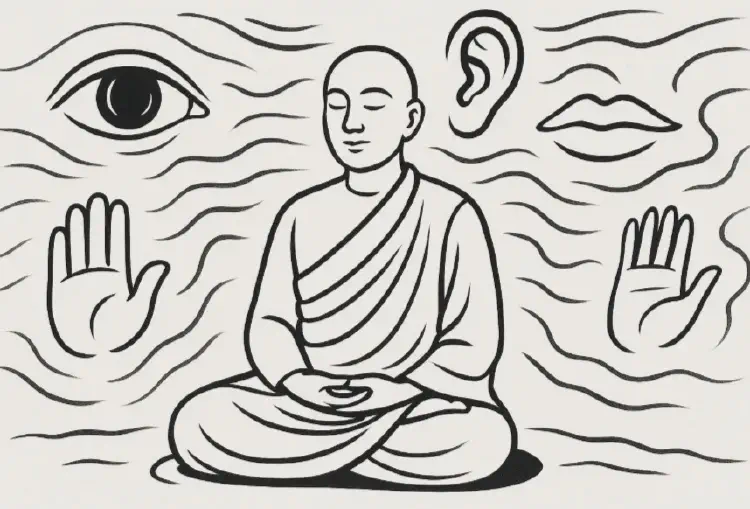
The Nature of Sensory Experiences:
- Ordinary perception treats senses as external inputs received by a perceiving self.
- In Dzogchen, sensory experiences—sights, sounds, tastes, smells, touches—are expressions of awareness itself.
- Awareness is not behind or separate from senses; it is vividly present within them.
How to Practice Recognition in Sensory Experiences:
- Sit in a relaxed posture and allow awareness to remain open.
- Choose a sense (such as sound) and notice how it arises naturally without effort.
- Instead of focusing on the object of the sense, recognize the awareness in which the perception appears.
- Apply the same approach to other senses, letting each perception remind you of rigpa.
Key Realization:
- Awareness is not limited to thoughts or inner states—it pervades all sensory experiences.
- Sights and sounds arise like reflections in a mirror: vivid, clear, but without substance.
- When recognized, senses no longer trap attention but become gateways to liberation.
Benefits of This Practice:
- Breaks the dualistic habit of ‘me here’ and ‘world out there.’
- Transforms ordinary life into practice—walking, listening, eating all become reminders of awareness.
- Deepens confidence that rigpa is unbroken and ever-present.
Analogies:
- Like waves in the ocean—senses arise and dissolve in the vast sea of awareness.
- Like an echo in space—perceptions appear, resonate, and fade without leaving a trace.
Summary: Recognizing awareness in sensory experiences reveals that rigpa is not separate from perception. Every sound, sight, or sensation is an opportunity to recognize the vast openness of awareness itself.