Integrating stillness and movement
Longde teachings emphasize that awareness is not confined to meditation stillness. True stability comes when recognition of rigpa continues seamlessly through both stillness and movement.
- Dzogchen Essentials
- 2 min read
Article 5 of 6 in Longde Practices/
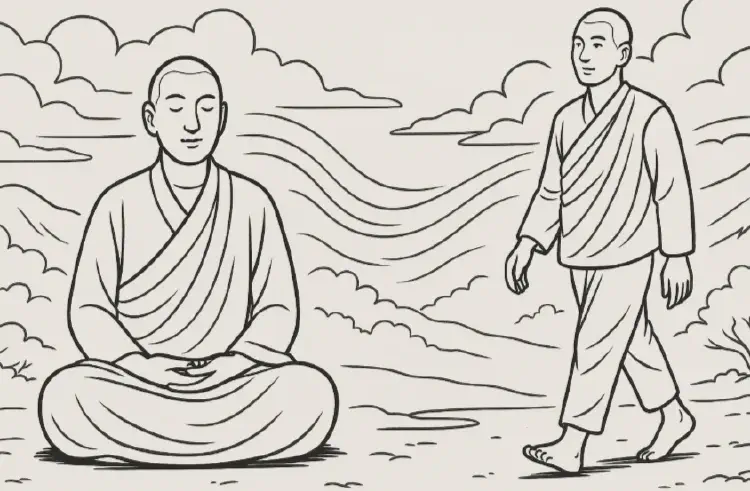
Stillness in Practice:
- Sitting meditation offers a stable environment where distractions are reduced.
- In stillness, recognition of awareness becomes clearer and easier to sustain.
- This phase helps beginners familiarize themselves with rigpa without overwhelm.
Movement in Practice:
- Everyday life involves constant activity—walking, speaking, working, relating.
- Dzogchen does not separate practice from life; the challenge is to sustain recognition amid movement.
- Movement becomes a test and confirmation of stability: if rigpa is genuine, it remains unshaken in activity.
Integrating Stillness and Movement:
- Begin in stillness, recognizing rigpa during sitting or sky-gazing.
- Slowly shift into movement—walking, breathing, simple gestures—while maintaining awareness.
- Expand to daily activities, using ordinary actions as reminders of awareness.
- Recognize that stillness and movement are not opposites but expressions within awareness.
Key Insight:
- Awareness is like the open sky; stillness and movement are like clouds—different expressions but inseparable from the vast space.
- When fixation drops, both stillness and movement are recognized as self-arising and self-liberating.
Benefits of Integration:
- Prevents compartmentalizing practice as only for meditation sessions.
- Strengthens confidence that awareness pervades all circumstances.
- Leads to spontaneous presence where life itself becomes the field of practice.
Summary: In Longde, integrating stillness and movement ensures that recognition of rigpa is not limited to meditation but continues effortlessly in all activities. Awareness remains stable, unbroken, and boundless whether the body is still or in motion.