Techniques for cutting through conceptual elaborations
Dzogchen emphasizes direct recognition of awareness, which can be obscured by endless conceptual elaboration. Semde practices provide methods to cut through these layers of thought and return to the natural state.
- Dzogchen Essentials
- 2 min read
Article 3 of 6 in Semde Practices/
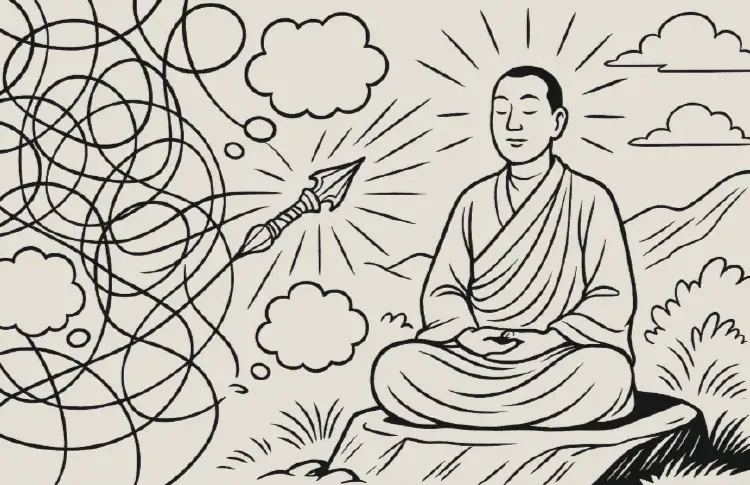
What Are Conceptual Elaborations?
- Elaborations (prapañca) are the mind’s tendencies to analyze, categorize, and proliferate thoughts.
- They create complexity and obscure direct recognition of rigpa.
- Examples include overthinking, constant labeling, or philosophizing about experience.
Why Cutting Through is Necessary:
- Awareness cannot be grasped conceptually.
- Clinging to ideas—even about Dzogchen—keeps one in dualistic mind (sem).
- Cutting through reveals simplicity: the clear openness of rigpa.
Techniques in Semde:
- Resting Without Alteration: Whenever thoughts arise, do not chase, suppress, or analyze—simply rest in awareness.
- Short Glimpses Repeated Often: Return again and again to the open clarity of mind, training familiarity with rigpa.
- Using the Sky Analogy: Gaze at the open sky, recognizing thoughts as clouds that cannot obscure its vastness.
- Letting Go of Grasping: When conceptual analysis begins, notice it and allow it to dissolve naturally without force.
Practical Pointers from Masters:
- “Leave it as it is, without correcting.”
- “Do not follow after the past, do not anticipate the future, rest in the present.”
- “Thoughts liberate themselves the moment they arise.”
Benefits of Cutting Through:
- Reduces attachment to intellectualization.
- Frees the practitioner from mental restlessness.
- Reveals the simplicity of rigpa, beyond elaboration.
Summary: Techniques for cutting through conceptual elaborations help the practitioner stop complicating experience with unnecessary analysis. By letting thoughts arise and dissolve naturally, one rests in the uncontrived simplicity of awareness itself.