Self-liberation of thoughts
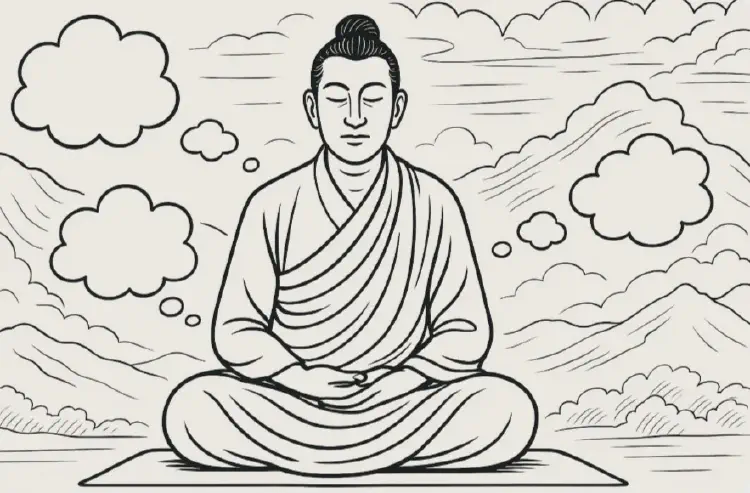
In Dzogchen, thoughts are not enemies to be suppressed, nor distractions to be eliminated. Instead, they are seen as natural expressions of awareness that can liberate themselves the moment they arise.
- Dzogchen Essentials
- 2 min read
Article 5 of 6 in Direct Introduction/
The Principle of Self-Liberation:
- Thoughts, emotions, and perceptions continuously arise in the mind.
- In ordinary perception, these are grasped at, solidified, and turned into chains of karma.
- In Dzogchen, when resting in rigpa, each thought liberates naturally without effort—like writing on water that disappears instantly.
Difference from Other Approaches:
- Sutra path: Often emphasizes analyzing thoughts or developing mindfulness to cut their power.
- Tantra path: May transform thoughts into enlightened qualities through visualization and mantra.
- Dzogchen: Recognizes thoughts as expressions of awareness itself, requiring no suppression or transformation.
How Self-Liberation Works in Practice:
- A thought arises—anger, joy, or distraction.
- Instead of following it or rejecting it, simply rest in awareness.
- The thought dissolves on its own, revealing the clarity of rigpa.
Analogies Used in Dzogchen:
- Clouds in the sky: Thoughts arise but dissolve back into the vast openness of awareness.
- Writing on water: No trace remains once the thought disappears.
- Snake uncoiling itself: The thought resolves without external force.
Why This is Essential:
- Self-liberation prevents attachment and aversion, allowing natural spontaneity.
- It reveals that awareness is never disturbed by the play of thoughts.
- It ensures practice is effortless—resting in what is, rather than fabricating mental control.
Practical Reminder:
- The goal is not to stop thoughts but to recognize their nature.
- With familiarity, every arising thought becomes a reminder of rigpa.
In summary, the self-liberation of thoughts shows that awareness does not need protection from the mind. Instead, thoughts themselves reveal awareness when left untouched.