View, Meditation, and Conduct in Dzogchen
In Dzogchen, the path is often summarized as view, meditation, and conduct. These three aspects describe how one relates to awareness, how one stabilizes it, and how one integrates it into daily life.
- Dzogchen Essentials
- 2 min read
Article 6 of 6 in Foundations of Dzogchen/
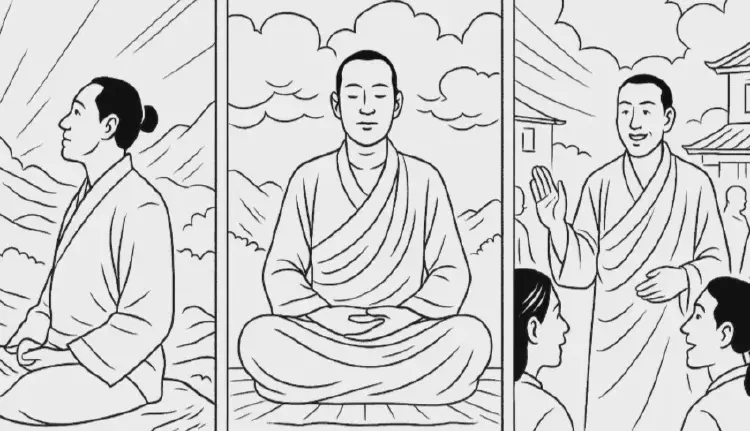
The View (tawa):
- The view of Dzogchen is that the true nature of mind—rigpa—is already pure, luminous, and complete.
- Enlightenment is not something to be constructed or attained in the future; it is recognized as ever-present.
- This view cuts through dualistic concepts of samsara and nirvana, seeing both as expressions of the same ground.
Meditation (gompa):
- Meditation in Dzogchen is unlike fabricated concentration practices. It is often described as non-meditation.
- The practice is to rest naturally in awareness without effort, neither trying to suppress thoughts nor follow them.
- Through direct introduction by a teacher, the practitioner recognizes rigpa and repeatedly returns to that recognition until it becomes stable.
- Meditation is not about achieving altered states but about recognizing what is already here.
Conduct (chöpa):
- Conduct arises spontaneously from the stability of awareness.
- Unlike ethical rules imposed externally, conduct in Dzogchen flows naturally from realization—it is compassionate, wise, and effortless.
- Everyday activities—speaking, working, relating with others—become expressions of awareness.
- Challenges and emotions are integrated into the path, self-liberated in the moment they arise.
Integration of the Three:
- View provides the understanding of the nature of mind.
- Meditation makes that view experiential and stable.
- Conduct ensures that realization is lived, not just glimpsed in meditation.
In essence, Dzogchen does not separate practice from life. The unity of view, meditation, and conduct allows the practitioner to embody awareness in every aspect of existence.