Difference between Sutra, Tantra, and Dzogchen
Tibetan Buddhism encompasses multiple vehicles of practice. Sutra, Tantra, and Dzogchen each offer distinct approaches, yet they ultimately aim toward the same realization of enlightenment.
- Dzogchen Essentials
- 2 min read
Article 4 of 6 in Foundations of Dzogchen/
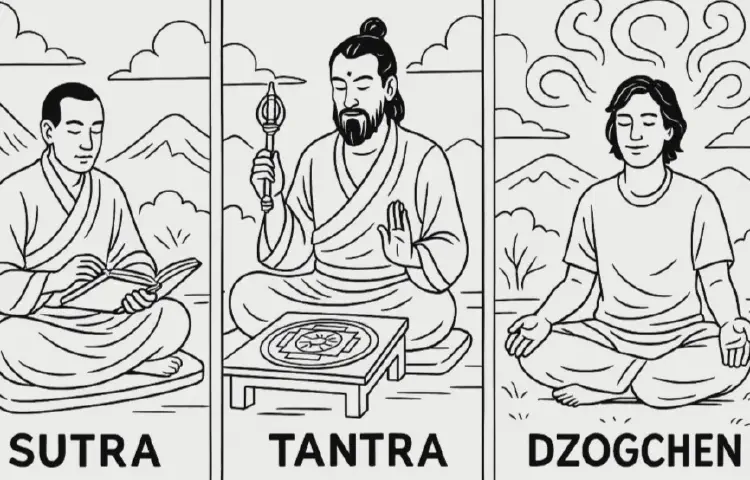
The distinctions between Sutra, Tantra, and Dzogchen lie in their methods, views, and directness of approach to awakening.
Sutra Path (Gradual Approach):
- Focus: Ethical discipline, meditation, and wisdom.
- Method: Gradual accumulation of merit and insight through study, reflection, and meditation.
- View: Enlightenment is attained step by step, often over many lifetimes, by cultivating bodhicitta and practicing the six perfections.
- Analogy: Like slowly climbing a mountain with careful effort.
Tantra Path (Transformative Approach):
- Focus: Transformation of body, speech, and mind into enlightened qualities.
- Method: Visualization of deities, mantra recitation, ritual practices, and working with subtle energies.
- View: The practitioner transforms ordinary perception into pure perception, using symbolic and energetic methods.
- Analogy: Like taking a hidden path up the mountain—faster, but requiring special guidance and care.
Dzogchen Path (Direct Approach):
- Focus: Direct recognition of rigpa (pristine awareness).
- Method: Direct introduction from a teacher and resting in natural awareness without fabrication.
- View: Enlightenment is not something created but recognized as already fully present. Practices aim to remove obscurations rather than construct realization.
- Analogy: Like recognizing that you were already at the summit of the mountain—you simply turn around and see.
Key Differences Summarized:
- Sutra emphasizes gradual cultivation.
- Tantra emphasizes transformation through symbolic means.
- Dzogchen emphasizes direct recognition and resting in the natural state.
Despite their differences, these three approaches complement one another. Many practitioners engage in Sutra and Tantra practices as preparation before receiving Dzogchen instructions.
You might also like:
- Tags:
- Direct Introduction
- Direct Recognition
- Natural Awareness
- Body Speech
- Natural State
- Analogy Like
- Emphasizes Direct
- Dzogchen Instructions
- Dzogchen Emphasizes
- Ordinary Perception
- Mantra Recitation
- Subtle Energies
- Ethical Discipline
- Pristine Awareness
- Transforms Ordinary
- Emphasizes Direct Recognition
- Dzogchen Emphasizes Direct